
What a relief rally is good for
My own SUI strategy has never sold a single coin. It started with coins I’d bought earlier, at a much higher price than today’s, and it buys €10 on every deep daily dip and sell €10 on every strong daily rise, never below cost. The buys did their job and pulled the average cost down. The sells never fired, because SUI has not traded above that average cost once since.
Then I looked at SUI’s chart since the crash of 10 October 2025. The coin fell from €2.64 to €0.99, and on the way down it jumped hard at least four times. A relief rally: a short, sharp bounce inside a market that keeps falling afterwards. None of those rallies came anywhere near what I’d paid. But a strategy that started from cash, and bought only on the way down, would have had a much lower average cost to beat.
So I asked a different question. What if the strategy did not sell in €10 slices, but sold everything on the first rally above its average cost, and then started over?
The rule
I kept the settings of my real SUI strategy and changed one thing:
- Check the price once a day.
- Buy €10 when a day closes 5% or more below the day before.
- Sell everything when a day closes 6% or more above the day before, as long as the price is above the average cost plus 0.5%. That margin covers the fees, and the ACB Guard enforces it: Aurono never sells below cost.
Aurono Start has no “sell everything” switch, and it doesn’t need one. Under Sell when price rises, set the Amount to more than the position could ever be worth, for example €1,000. Aurono sells the coins the strategy holds, and stops there.
I’ll call everything from the first buy until the sale that empties the position a round. After a sale the position is empty, so the next dip starts a new round.
A year of SUI, replayed
I replayed this rule on Bitvavo’s daily SUI-EUR prices from 10 October 2025 to 10 October 2026, starting with cash and no coins.
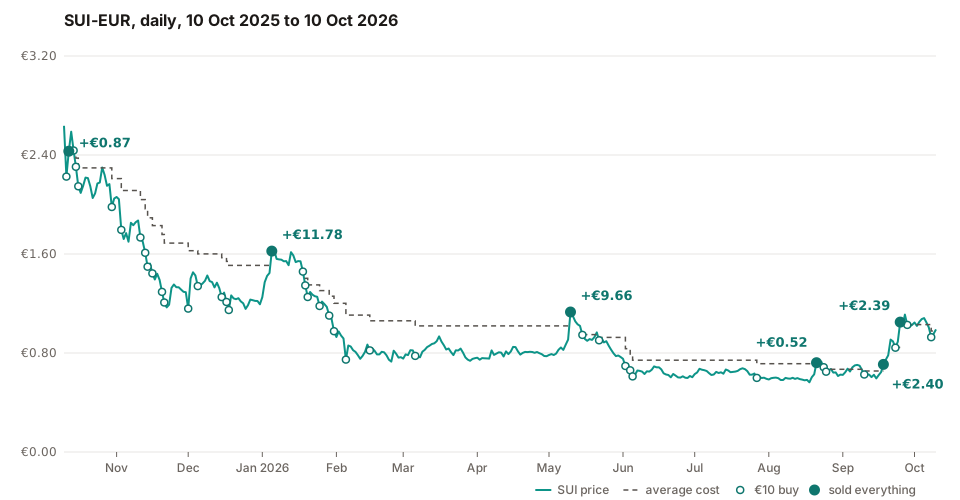
Every filled dot is a sale of the whole position. The dashed line is the average cost of the round in progress: it steps down with every buy and ends at the sale.
| Round | Buys | Put in | Average cost | Sold at | Result |
|---|---|---|---|---|---|
| 11 to 12 Oct 2025 | 1 | €10 | €2.23 | €2.43 | +€0.87 |
| 14 Oct 2025 to 5 Jan 2026 | 16 | €160 | €1.51 | €1.62 | +€11.78 |
| 18 Jan to 10 May | 9 | €90 | €1.02 | €1.13 | +€9.66 |
| 15 May to 21 Aug | 6 | €60 | €0.71 | €0.72 | +€0.52 |
| 24 Aug to 18 Sep | 3 | €30 | €0.65 | €0.71 | +€2.40 |
| 23 to 25 Sep | 1 | €10 | €0.85 | €1.05 | +€2.39 |
Six closed rounds, +€27.61 in total, in a year where SUI lost 62% of its price. A seventh round is open: two buys since 28 September, at an average cost of €0.98, with the price at €0.99.
The sales line up with the bounces you can see on any SUI chart: early January, the spike of 9 and 10 May, late August, and the climb in the second half of September.
Why the average cost starts over
My real strategy carries its starting position. Every buy lowers the average cost a little, but €10 at a time against a position bought far above today’s price moves the average slowly. A rally has to beat that average, and in this market no rally did. I also replayed the sell-everything rule from my real starting position: it would not have closed a single round either.
A round that sells everything leaves nothing to average. The next round’s cost is made only of new buys, at the prices of that moment. A relief rally then only has to beat the average cost of the current round, not the price of the top a year ago. In January the bar was €1.51. By September it was €0.65.
The part that decides everything: cash
The second round took 16 buys and €160, and it lasted twelve weeks. The rule only works if the cash for every one of those buys is there. With €200 of cash, room for 20 buys, it always was: the six rounds return +13.8% on that €200, in a year where SUI lost 62%. Here is the same rule on the same coin with €100 of cash:
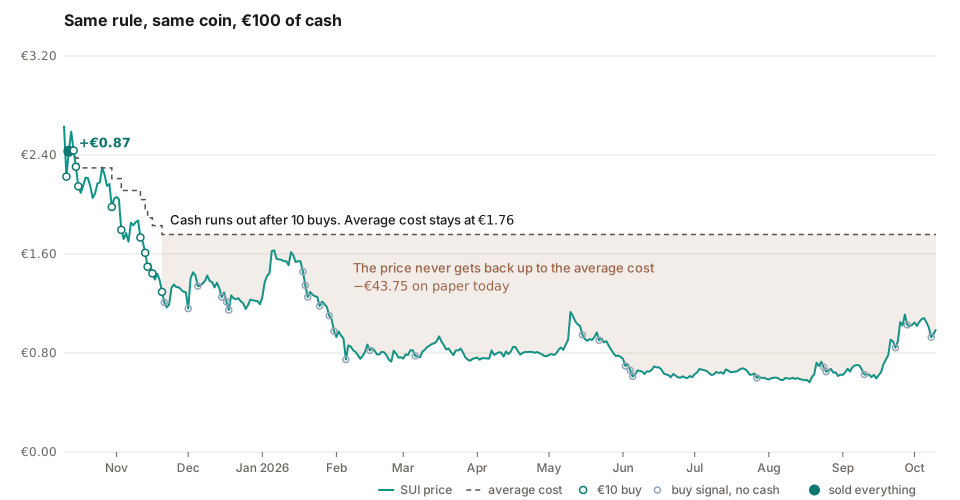
With €100, the cash runs out on 20 November. Every buy signal after that is one the strategy cannot act on.
The cash is gone after ten buys, on 20 November, with an average cost of €1.76. After that, 27 buy signals arrive with no cash to act on. The strongest rally after that, in early January, reaches €1.63: close, but below the bar. The strategy closes one round for +€0.87 and has been holding a loss since. Today the loss is −€43.75 on paper.
Same rule, same coin, same year. One version closed six rounds, the other closed one. The only difference was cash, and you only learn how much cash a bear market needs once it’s over.
What else to keep in mind
- The rally has to arrive in one day. The sale needs a single daily close at least 6% above the day before. A rally spread over a week of +3% days sells nothing, however far above the average cost it ends.
- Some rounds barely clear the bar. The round from May to August made €0.52 on €60. The rally reached the average cost and not much more.
- I picked SUI after seeing its chart. The settings are the ones my real strategy already had, not tuned to this year, but the coin and the starting date were chosen with hindsight. A coin that keeps falling without real rallies would show you open rounds, not closed ones.
- This is a replay, not trades I made. Fills are at the daily close, with a 0.25% fee on every buy and sale and no slippage. Live fills land a little differently.
- After a sale, the strategy buys the next dip. That’s the point of the approach. If you think the coin has had its last bounce, pause the strategy or set the buy Amount to €0.
How I’d set it up
- Decide how much cash you can leave in the coin for a long time. Divide it by the buy amount: that’s how many dips the strategy can buy before it runs dry. In this replay, the deepest round needed 16.
- Set the sell amount far above anything the position could be worth. Aurono sells only the coins it holds.
- Try it before it trades. Run it in the Lab first, then as a new strategy in shadow mode, before any real money is involved.
Selling in small slices on the way up is a different approach, with its own strengths. The ONDO case study, Locking in profit while the price falls, shows how that one works.
My own SUI strategy still waits for a rally above its average cost, and its starting position explains why. For a round that starts from cash, I’d rather sell everything into the next relief rally than wait for a price that may not come back.
Want to try this yourself at no cost? Download Aurono Start and run it in shadow mode. It follows live prices and shows you exactly what it would have done, every buy, every sale and every blocked signal, without touching a cent of real money. When you’re ready, the same strategy goes live with one switch.
→ Download Aurono Start · How shadow mode works · Play with a strategy in your browser