
Not every dip deserves a buy: introducing RSI confirmation
A strategy that buys every sharp drop treats a real bottom and a stop along the way down exactly the same. Both look identical to a price trigger: the same size move, the same distance below yesterday’s close. During a genuine bear market, that’s most of what a price-only trigger sees. Drop after drop, each one a plausible buy, most of them followed by another drop.
The problem with a price trigger alone
Your drop sensitivity fires on how big a move is relative to recent volatility. It has no sense of whether the broader trend already spent itself, or whether this drop is just the next leg down. In a choppy market that’s rarely a problem: drops and bounces cancel out. In a sustained bear market, it means a harvesting strategy keeps buying into weakness with no signal telling it the weakness might still have room to run.
RSI confirmation: a second opinion before the trade
RSI confirmation is a new, optional condition you can add to any strategy. Buy only fires when price has already dropped and RSI says the market is oversold. Sell only fires when price has already risen and RSI says overbought. It’s AND-composed with your existing price trigger: RSI can only hold back a signal the price trigger already produced, never create one on its own.
Off by default. One click on ”+ Add RSI condition” fills in the standard convention (a 14-period RSI, buy below 30, sell above 70), and every value is yours to adjust from there. Once added, it shows up everywhere your strategy already explains itself: the pipeline preview, the plain-language summary, the audit trail, and the chart.
If you want the mechanics of what RSI actually measures and why 30 and 70 became the defaults, we covered that separately in What RSI actually measures.
Testing it against last year’s bear market
We ran both versions of a BTC-EUR daily strategy through Lab → Simulate over the past year: drop and rise sensitivity at 2.0 (roughly 4.6% and 4.4% thresholds), €100 per buy and sell, €1,000 starting capital. Over this exact stretch, simply buying once and holding lost 31.8%.
Without RSI confirmation
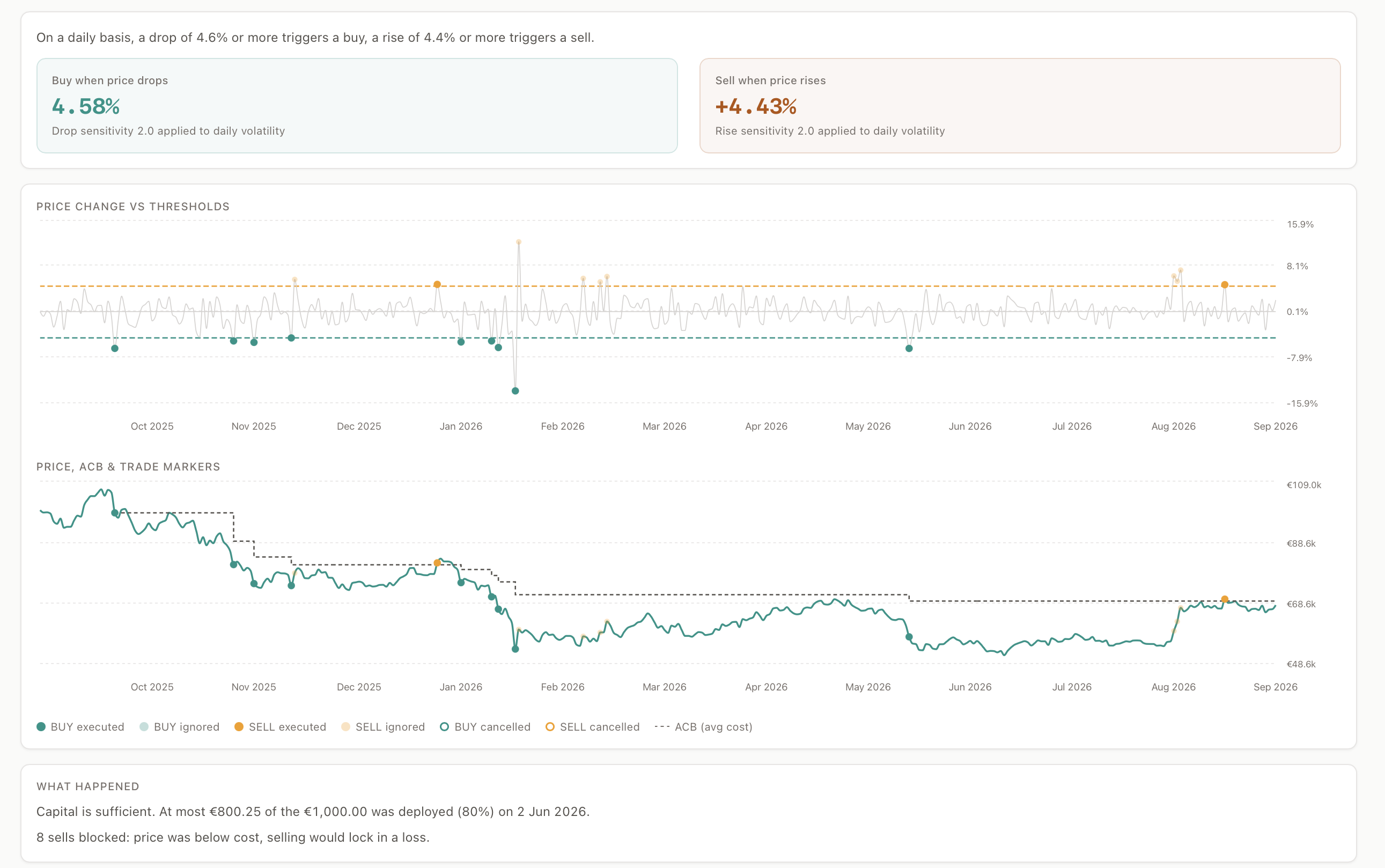
Nine buys, two sells. Up to 80% of the €1,000 got deployed at once. Eight more sell signals were blocked outright, because price hadn’t cleared the average cost yet. The strategy ended at €985.33, down 1.5%, and came in slightly behind simply dollar-cost-averaging into BTC over the same year (-0.5%). Still well ahead of buy-and-hold.
With RSI confirmation
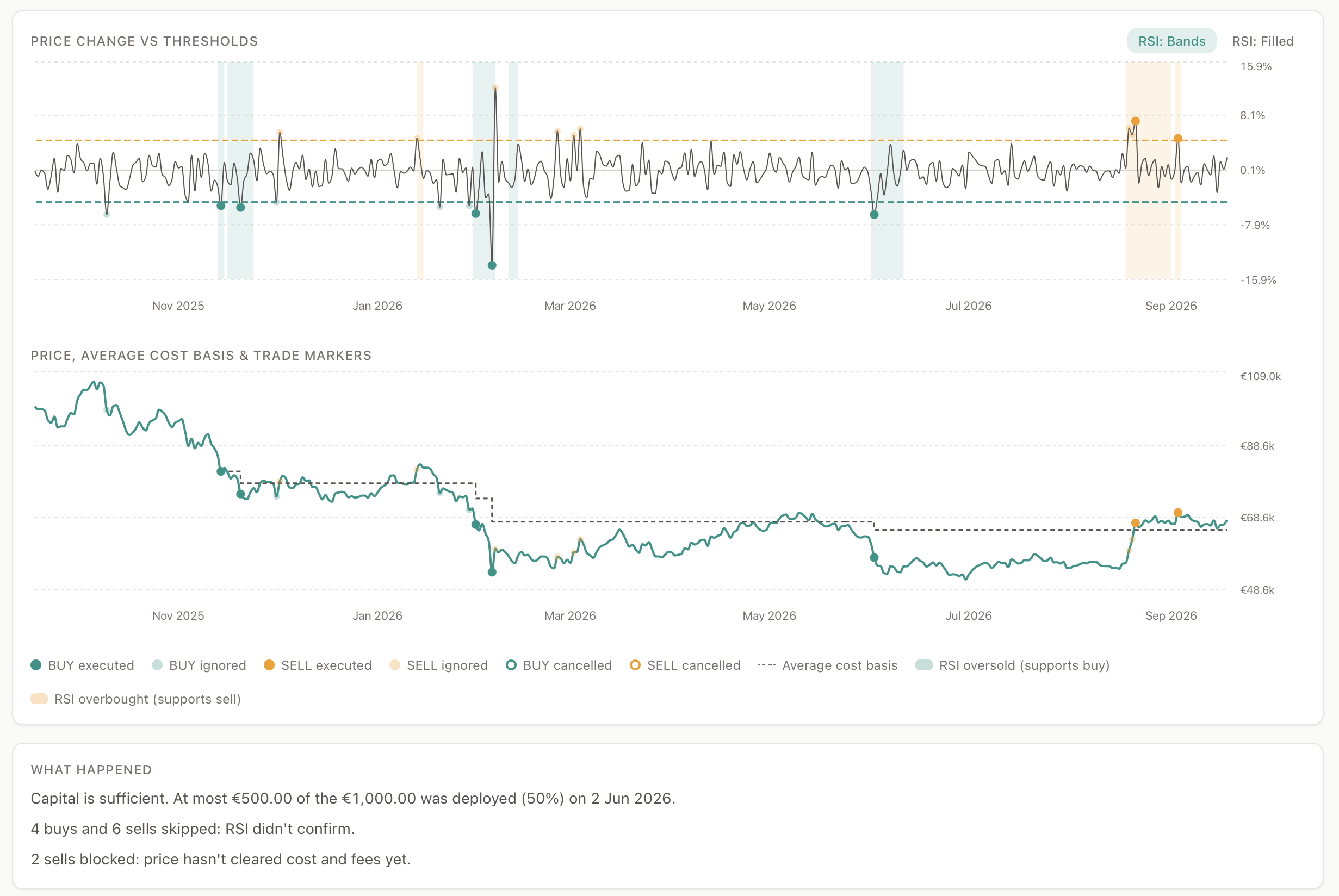
Same price triggers, same thresholds. RSI held back a run of buy signals that fired on price alone but weren’t backed by an oversold reading, and it held back sell signals the same way on the other side. Less capital went in on the way down. The strategy ended up 2.7%, beating monthly DCA by €32.19 and buy-and-hold by €345.50. Only two sell signals were blocked by the cost floor, down from eight.
What actually changed
Fewer trades, not more. RSI confirmation didn’t add a new way to buy, it removed the buys that a price trigger alone would have taken but momentum still called falling. With less capital committed to those, the average cost basis stayed lower, and the two sells that did happen had more room to clear it. That’s the whole idea behind pairing a price trigger with RSI: don’t just buy on a drop, buy when RSI also says oversold.
One backtest, not a promise
This is one asset, one year, one specific bear market. A different year, a different asset, or a choppier market that isn’t trending could easily tell a different story; RSI confirmation trades fewer signals in exchange for more selective ones, and selectivity isn’t free in every market. Run it against your own strategy in Lab → Simulate before assuming it repeats. Past performance doesn’t guarantee future results.
RSI confirmation is rolling out in this release. Add it to any strategy from Create Strategy, Lab → Simulate, or Quick Test.