What Is a Strategy
A strategy defines exactly when Aurono is allowed to buy and sell.
It is a set of explicit rules that Aurono executes automatically and without interpretation.
Aurono does not invent strategies.
It does not adapt them.
It only executes what you define — within strict safety constraints.
A Strategy Is a Contract
Section titled “A Strategy Is a Contract”Think of a strategy as a contract between you and Aurono:
- You define the rules
- Aurono enforces them precisely
- Nothing happens outside those rules
If a rule is not triggered, Aurono does nothing — even if that feels counter-intuitive.
This is intentional.
Core Components of a Strategy
Section titled “Core Components of a Strategy”All strategy components are configured in the Add Strategy form in the Aurono dashboard and on the Strategies page.
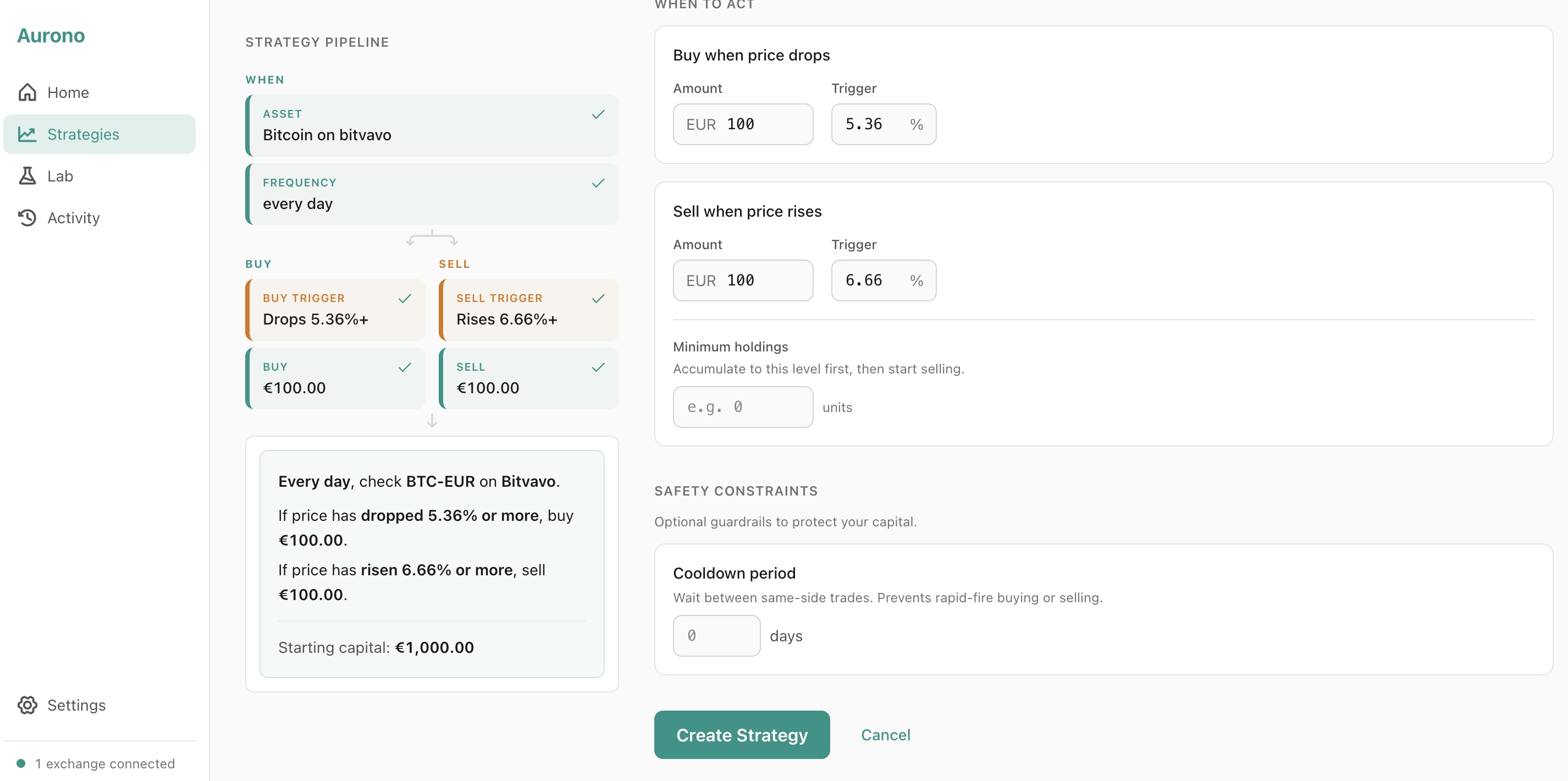
Each field in this form corresponds directly to the components explained below.
Every Aurono strategy consists of the following components:
Exchange
Section titled “Exchange”The exchange where orders are placed.
A strategy always operates on one exchange only.
Trading Pair
Section titled “Trading Pair”The asset pair to trade, for example:
- BTC / EUR
- ETH / EUR
- SOL / EUR
Aurono always trades the quote currency against the base asset, as defined by the pair.
Timeframe
Section titled “Timeframe”The timeframe defines how often price movement is evaluated.
Examples:
- 1h → evaluated every hour
- 4h → evaluated every 4 hours
- 1d → evaluated once per day
Aurono evaluates rules only when a candle closes.
Buy Trigger (Drop %)
Section titled “Buy Trigger (Drop %)”The minimum percentage drop required to trigger a buy.
Example:
- Buy trigger: −4%
This means:
Aurono will only buy if the current closed candle has dropped at least 4% compared to the previous candle.
Sell Trigger (Rise %)
Section titled “Sell Trigger (Rise %)”The minimum percentage rise required to trigger a sell.
Example:
- Sell trigger: +6%
This means:
Aurono will only consider selling if the current closed candle has risen at least 6% compared to the previous candle.
Average Cost Base (ACB) Rule — Very Important
Section titled “Average Cost Base (ACB) Rule — Very Important”Aurono applies an additional capital-preservation rule:
Aurono only sells when the sell price is above the strategy’s average cost base.
This means:
- Even if the rise percentage condition is met
- Aurono will not sell at a loss
- Selling below the average cost base is explicitly prevented
This rule is not configurable and applies to all strategies.
It ensures that:
- Partial sells do not realize losses
- Capital erosion through repeated loss-taking is avoided
- Strategies remain accumulation-focused by design
Order Amounts
Section titled “Order Amounts”Defines how much is bought or sold per trade.
- Buy amount: fixed currency amount per buy
- Sell amount: fixed currency amount per sell
These amounts are not time-based and do not depend on frequency.
Allocated Capital
Section titled “Allocated Capital”The maximum capital this strategy is allowed to use.
Aurono will:
- Never exceed this allocation
- Never borrow funds
- Never use margin
When the allocation is fully used, buying stops automatically.
“I Already Own This Coin”
Section titled ““I Already Own This Coin””This option indicates that you already hold the selected asset before activating the strategy.
When enabled, the strategy starts with an existing position, allowing Aurono to immediately apply selling rules and average cost base logic.
If disabled, the strategy starts with zero holdings and will only acquire assets through future buys.
What a Strategy Is Not
Section titled “What a Strategy Is Not”A strategy is not:
- A prediction
- A signal
- A recommendation
- A guarantee of profit
Aurono does not try to be right.
It tries to be consistent and capital-preserving.
Example Strategy (Conceptual)
Section titled “Example Strategy (Conceptual)”Trade BTC/EUR
Timeframe: 4h
Buy at −4%
Sell at +6%
Buy amount: €100
Sell amount: €100
Allocated capital: €1,000
Aurono will:
- Wait for a 4-hour candle to close
- Buy only after a qualifying drop
- Sell only after a qualifying rise and above average cost base
- Repeat as long as capital and conditions allow
If price rises but remains below average cost base, no sell occurs.
This is expected behavior.
Determinism Over Activity
Section titled “Determinism Over Activity”A well-defined strategy often feels boring.
That is a feature, not a bug.
Aurono prioritizes:
- Determinism
- Predictability
- Capital discipline
- Rule adherence
Not trade frequency.
Why This Matters
Section titled “Why This Matters”Understanding what a strategy is helps avoid common mistakes:
- Expecting continuous activity
- Assuming every rise leads to a sell
- Confusing inactivity with failure
- Underestimating the role of cost base
- Over-optimizing after short timeframes
A strategy needs time and consistency to express its behavior.