Timeframes Explained
The timeframe defines when Aurono evaluates price movement for a strategy.
Aurono does not react to every price change.
It evaluates rules only when a candle closes.
Understanding this behavior is essential to understanding why Aurono acts - or does nothing.
What a Timeframe Represents
Section titled “What a Timeframe Represents”A timeframe is the duration of one price candle.
Examples:
- 1h → one candle represents one hour
- 4h → one candle represents four hours
- 1d → one candle represents one day
Aurono evaluates strategy rules once per candle, at the moment the candle closes.
How Candles Work (OHLC)
Section titled “How Candles Work (OHLC)”Each candle contains four prices:
- Open - the price at the start of the candle
- High - the highest price reached during the candle
- Low - the lowest price reached during the candle
- Close - the price at the end of the candle
Aurono uses only the closed candle for evaluation.
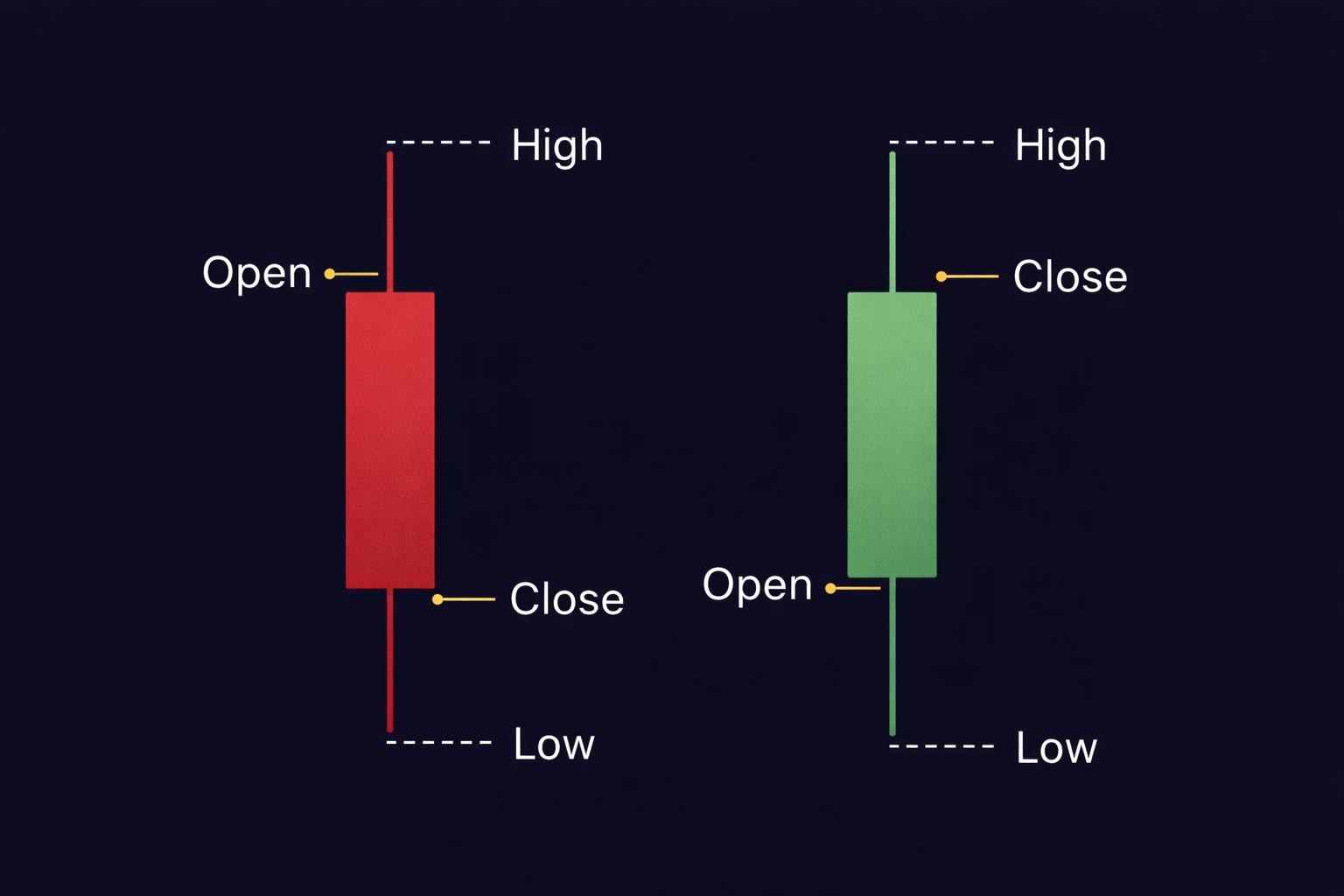
- A red candle closes below its open
- A green candle closes above its open
- Wicks show price movement that occurred within the candle
Why Aurono Uses the Close Price
Section titled “Why Aurono Uses the Close Price”Aurono bases decisions on the Close, not on the High or Low.
This means:
- Price may move far during the candle
- But if it recovers before the candle closes
- No action is taken
Aurono ignores intraperiod movement.
This ensures:
- Deterministic behavior
- Consistent execution
- No dependence on timing or latency
This is intentional.
Example: No Action Despite Movement
Section titled “Example: No Action Despite Movement”Assume:
- Timeframe: 4h
- Buy trigger configured
During the candle:
- Price moves below the trigger
- Later recovers
- Candle closes above the trigger level
Result:
No buy occurs
Aurono evaluates only the closed candle.
Timeframe and Percentages Work Together
Section titled “Timeframe and Percentages Work Together”A percentage only has meaning in combination with its timeframe.
Aurono compares:
- The close of the previous candle
- With the close of the current candle
It does not react to:
- Intraperiod highs
- Intraperiod lows
- Temporary spikes or dips
How to Think About Timeframes
Section titled “How to Think About Timeframes”Timeframe defines when Aurono evaluates.
Percentages define what Aurono waits for.
They must always be considered together.
Always configure:
- Timeframe
- Buy trigger (Drop %)
- Sell trigger (Rise %)
As a single system, not independent settings.
One Timeframe per Strategy
Section titled “One Timeframe per Strategy”Each strategy uses exactly one timeframe.
If you want to evaluate multiple horizons, create multiple strategies.
Each strategy is evaluated independently.
Common Misunderstandings
Section titled “Common Misunderstandings”“The price touched my level, why nothing happened?”
Because the candle did not close beyond the configured condition.
“Why didn’t Aurono react immediately?”
Because Aurono waits for the candle to close.
“Nothing happens for a long time.”
This can be normal behavior depending on configuration.
Key Takeaway
Section titled “Key Takeaway”Aurono executes rules, not reactions.
- It waits
- It evaluates at candle close
- It acts only when conditions are met
If nothing happens, the rules were simply not met.
Next Page
Section titled “Next Page”Continue with:
Buy Trigger (Drop %)
/strategy-builder/buy-trigger
Timeframes define when Aurono looks.
Triggers define what Aurono waits for.